
Iron in the signal path. Character in every track.
Price coming soon
In development. Made to order.
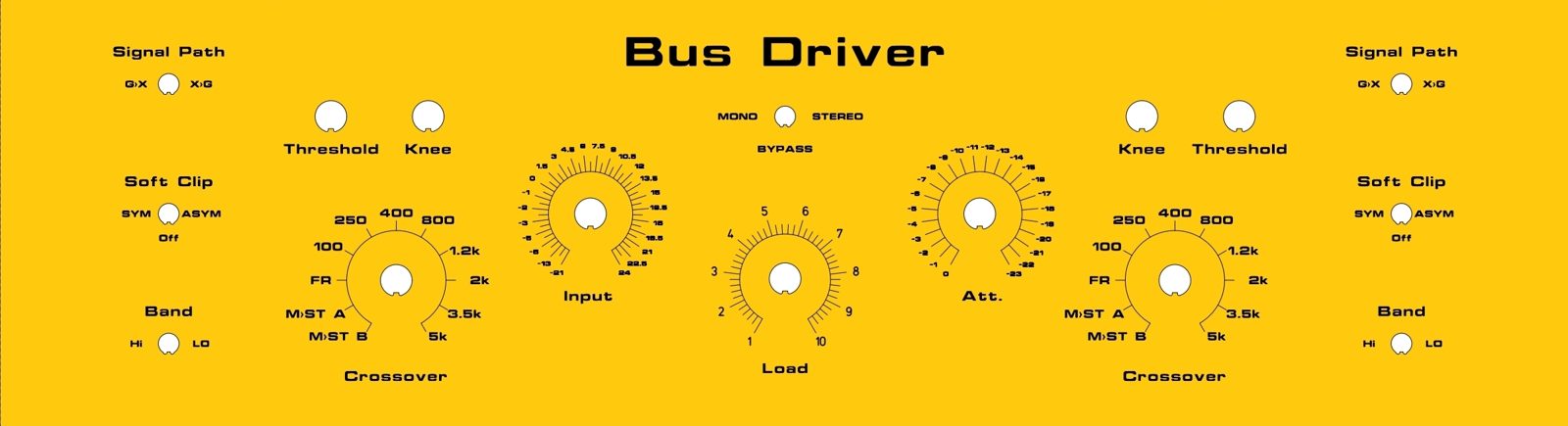
The Bus Driver is a stereo saturation box with serious tone shaping. It adds transformer character, saturation, and distortion to the signal, with control over how much and what kind. It's a stereo process unit, not two mono units in a box.
The signal path
- Gain
Up to +24 dB of clean gain, from clean to distorted, with overdrive voicings in the spirit of the Tube Screamer and the OD-1. Soft-clipping LEDs can be set symmetrical or asymmetrical, per channel. The two potentiometers connected to the clipping LEDs adjust the clipping threshold and knee width, giving each channel a variable-width soft-knee clipper. - Crossover
A Sallen-Key crossover, intentionally colored, splits the signal into a low band and a high band. Choose the split at 10 Hz full range, 100 Hz, 250 Hz, 400 Hz, 800 Hz, 1.1 kHz, 2 kHz, 3.5 kHz, or 5 kHz. At unity gain, the filter creates a 3 dB reduction at the crossover frequency.
A switch on the front panel puts the gain stage before the crossover, or the crossover before the gain. With careful adjustment the filter can be driven to get unpredictable distortion. - Transformers
Kraftwerk Transformers.
Choose whether the low band or the high band drives the transformers. The transformer's harmonic saturation and distortion follows the input gain, from subtle to heavy. The large center knob sets the resistance the transformers see, which changes the character of the distortion. At the low setting of 600 ohms the response is what you'd expect. As more resistance is added, up to a maximum of 100 kohms, there are several sweet spots that deliver some really gorgeous distortion textures.
Mono in, stereo out
In Mono to Stereo mode, the left input drives both channels of the circuit.
Set each channel's crossover to a different point in the middle of the spectrum, with the gain at unity, and set the clipping LEDs and the transformer load differently on the left and right.
Asymmetric settings decouple the harmonic phase relationship between the input and the two different outputs, producing a true stereo image from a mono source without delay, pitch artifacts, or clocking noise.
Handmade by a working mix engineer who needed it and couldn't find it. Built because it didn't exist.
Using it
The Bus Driver rewards two hands and two ears. Set it while you listen, not while you look.
On the drum bus
All the detail comes to the front without crushing. The hits hit harder. You can hear distortion going on, but there's no fizz in it, only the gain-churning of the signal.
Technical
The details, for those who want to dig in.
Signal flow
- Crossover network
- Gain
- Soft clipping
- Transformers
- Attenuator
How to use it
- General saturation
Drum bus
Instrument bus
Mix bus
Individual track or sound - Tone shaping
Set the filter to high pass or low pass, with equal gain either way.
Low pass: saturates the signal below the filter frequency.
High pass: saturates the signal above the filter frequency. - Mono to stereo, modes A and B
Each side gets a different filter center frequency.
A is a modest spread.
B is a wider spread. - Stereo uses
Stereo image effect on an instrument submix.
A true mono to stereo effect, in series.